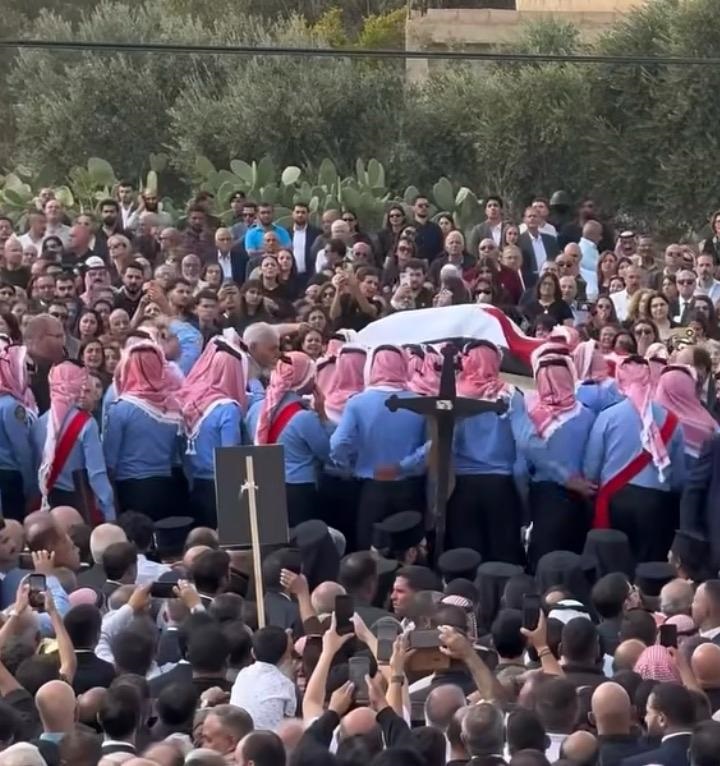
Previous Jordanians Rally at Hmoud for Funeral in a Strong Display of National Unity

By Nadine Nimri*
Writing was not easy amid the deep pain caused by the terrorist attack on the church in Hamoud village, Karak. What led me to write was what I observed on social media in the days that followed.
Like many Jordanians, I found myself checking my phone more often during those days, looking for information and following the news. Social media also became a place where people expressed the shock, grief, and anger we were all feeling. During the first two days, I was struck by the solidarity and unity in Jordanian online discussions. But then some comments and accounts began to take the conversation in a different direction, pulling the incident out of its original context.
So, what happened?
After years as an investigative journalist, I have grown used to asking what lies behind a statement: Who? When? Why? Those same questions led me to look more closely at some of the comments and try to find out more about the accounts posting them.
Some had been created only recently, used pseudonyms, and had no friends or followers. Others carried the label “AI-generated profile”. Some appeared to belong to people outside Jordan who were commenting on a local incident despite having no direct knowledge of Jordanian society.
These signs do not, on their own, prove that the accounts were fake or acting under specific instructions. But they do raise legitimate questions about the discussion we witnessed and how far it reflected the views of Jordanians themselves.
A study published by Analyseize before the terrorist attack in Hamoud, titled The Vocal Minority: How Jordanians Engage Online, offers useful context. According to the study, only 20% of users who engage with social media discussions express their views by commenting on posts. Another 51% interact silently, while 29% do not engage at all.
These figures raise an important question: How accurately do the comments we see on social media reflect public opinion? The number of people engaging with a particular view online does not necessarily tell us how widely that view is held in society, especially when many users follow discussions without taking part.
When considered alongside anonymous or fake accounts, and the possibility that some are used to amplify certain narratives or draw people into heated arguments, it becomes important to distinguish genuine differences of opinion among Jordanians from attempts to steer the discussion in a particular direction.
What actually happened on social media after the attack on the church in Hamoud?
A study by the Institute of Politics and Society, conducted after the terrorist attack, examined media coverage and online engagement between 23 and 26 October 2026. It found that the discussion had spread well beyond Jordan. More than 10 million interactions were recorded over four days, while posts about the incident rose from around 300 per hour to nearly 10,000 at the height of public attention.
The discussion took place in more than ten languages. The report found that around 38% of the Spanish-language content for which account locations could be identified came from accounts listing Israel as their location. It also identified extremist accounts outside Jordan that reworked news headlines.
In Jordanian coverage, national unity and Muslim-Christian solidarity were among the main themes. Coverage also highlighted the King’s visit to those injured in the attack, the victims’ stories and their funerals, bringing the human and national dimensions of the tragedy into focus.
The findings show a difference between how the incident was discussed in Jordan and how some content circulating beyond the country’s borders presented it. While Jordanian coverage focused on unity and solidarity, other accounts placed the incident within different religious and political narratives.
On the ground, the attack showed the strength of Jordanian solidarity. On social media, however, that unity faced a different challenge. Some comments shifted the conversation away from condemning the attack and standing with the victims towards heated arguments, provocation and attempts to draw people into a cycle of hostile exchanges.
The influence of some accounts may lie not only in what they post, but also in their ability to draw real users into these arguments. In this way, their reach can extend well beyond their own posts, shaping the wider discussion through the reactions they provoke.
What we saw after the attack points to the need to review how we respond to major events in the media. Publishing verified information quickly, clarifying the facts from the outset, and making the Jordanian perspective heard in different languages can all help leave less room for disinformation.
We also need to rethink what makes someone an influential voice in public debate. Reach alone is not enough. Credibility matters, as does the ability to present information accurately and in its proper context.
But monitoring fake accounts and tackling disinformation are only part of the picture. Hate speech is a much broader problem. A fake account used to influence a public discussion is not the same as a real person who holds exclusionary views or incites hatred against others. The two can overlap, but they are not interchangeable. Nor can hate speech as a whole be explained by attempts from outside the country to influence public opinion.
To address it, we need to look more closely at why some young people adopt these views or become drawn into such discourse. We need to understand their frustrations and aspirations, the information they are exposed to, and their ability to tell the difference between facts and disinformation, and between disagreement and incitement.
Before focusing the discussion on tougher penalties or other deterrent measures, we need a national prevention program that engages adolescents and young people. It should help them think critically, check information before believing or sharing it, and respect differences and diversity. It should also protect everyone’s right to express their views and, perhaps most importantly, give young people a sense that they have a supportive environment in which they can pursue their ambitions.
Protecting society from hate speech does not begin only when an offensive comment appears online. It begins with understanding why such messages find an audience in the first place, and helping people develop the awareness and judgment to think before they believe or share what they see.
Perhaps the question we need to ask today is not only: Who is behind these accounts? It is also: How do we stop public debate from being dominated by the loudest voices? And how do we make sure that social media does not become a place where the unity of our society is put to the test, while the genuine voices of Jordanians remain less visible?
The writer is a veteran Jordanian journalist*
تكافح مجلة “ملح الأرض” من أجل الاستمرار في نشر تقارير تعرض أحوال المسيحيين العرب في الأردن وفلسطين ومناطق الجليل، ونحرص على تقديم مواضيع تزوّد قراءنا بمعلومات مفيدة لهم ، بالاعتماد على مصادر موثوقة، كما تركّز معظم اهتمامها على البحث عن التحديات التي تواجه المكون المسيحي في بلادنا، لنبقى كما نحن دائماً صوت مسيحي وطني حر يحترم رجال الدين وكنائسنا ولكن يرفض احتكار الحقيقة ويبحث عنها تماشيًا مع قول السيد المسيح و تعرفون الحق والحق يحرركم
من مبادئنا حرية التعبير للعلمانيين بصورة تكميلية لرأي الإكليروس الذي نحترمه. كما نؤيد بدون خجل الدعوة الكتابية للمساواة في أمور هامة مثل الإرث للمسيحيين وأهمية التوعية وتقديم النصح للمقبلين على الزواج وندعم العمل الاجتماعي ونشطاء المجتمع المدني المسيحيين و نحاول أن نسلط الضوء على قصص النجاح غير ناسيين من هم بحاجة للمساعدة الإنسانية والصحية والنفسية وغيرها.
والسبيل الوحيد للخروج من هذا الوضع هو بالتواصل والنقاش الحر، حول هويّاتنا وحول التغييرات التي نريدها في مجتمعاتنا، من أجل أن نفهم بشكل أفضل القوى التي تؤثّر في مجتمعاتنا،.
تستمر ملح الأرض في تشكيل مساحة افتراضية تُطرح فيها الأفكار بحرّية لتشكل ملاذاً مؤقتاً لنا بينما تبقى المساحات الحقيقية في ساحاتنا وشوارعنا بعيدة المنال.
كل مساهماتكم تُدفع لكتّابنا، وهم شباب وشابات يتحدّون المخاطر ليرووا قصصنا.