Previous Israeli prison authorities are blocking hundreds of solidarity postcards being sent to female Palestinian prisoners

Reviewed by Daoud Kuttab

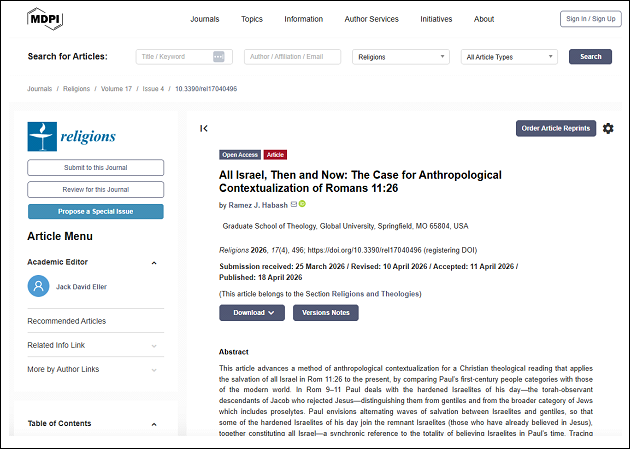
A new biblical academic study by Ramez J. Habash proposes an “anthropological contextualization” approach to read Romans 11:26 for today, arguing that Paul’s first‑century categories should be matched with contemporary human groupings—biological, ethnic, and religious—to translate the ancient text into a present‑day mission. Habash defines his method plainly: “I call this task anthropological contextualization, and by anthropological I refer to descriptors that define people, such as genetics, ancestry, and ethnicity,” insisting that the aim is to correlate ancient Scripture with current realities without forcing Paul’s categories onto today’s identities.
He adds that, “contextualized today, the expectation of all Israel’s salvation encompasses all nations, including Jews, without reconstituting Israel as a biological or national category distinct from the church.” He also cautions against biology‑driven, reductionist language, noting that he “avoid[s] expressions such as racial Israel or racial Jews, which obscure the biologically mixed nature of biblical Israel and later Jewish populations.”
Habash’s analysis centers on Paul’s three social categories in Romans 9–11: genealogical Israelites who believe in Jesus (the remnant), genealogical Israelites who are hardened, and gentiles‑in‑Christ who may have harbored conceit toward hardened Israelites.
He writes that Paul “is not announcing that after the fullness of gentile nations comes to faith and history approaches its end, God will reverse course and save most of the eschatological generation of Israelites.” Instead, he proposes that Paul envisions a pattern of salvation in which Gentiles and Israelites alternately join the Jesus communities.
Central to Habash’s reading is a nuanced handling of key terms. He argues that Paul’s use of achri hou and houtōs should be read as terminative and modal, signaling a recurring pattern of salvation rather than a single, final moment: “Paul is not revealing a temporal sequence but describing a recurring pattern of salvation by which gentiles and Israelites alternately join the Jesus communities.” He also treats Israel as a synchronic reference tied to Paul’s own time, yet he does not collapse this into an eschatological “Jewish generation” fixed for all future history. In Habash’s view, the Deliverer from Zion in 11:26–27 is not about Jesus’ second coming but about the ongoing saving work inaugurated in the present age, and the sequence of salvation extends across generations rather than culminating in one future moment.
A prominent part of Habash’s argument is his emphasis on anthropology as a corrective to longstanding interpretive tendencies. He contends that both dispensationalist and supersessionist readings assume a stable, biological Israel separate from the church, an assumption he calls a “theological construct.” He argues, “the Israel–church binary in dispensationalism is a theological construct,” and he critiques supersessionism for likewise presuming an exclusive, internal Israel that the church replaces. He concludes that “Regardless of one’s interpretation of Rom 11:26, we cannot anticipate an eschatological nation-state of Israel that would supersede the church or assume its vocation of blessing the nations.” The goal, he suggests, is a mission that includes all nations, not a fixation on a biologically continuous Israel.
Habash also engages contemporary data to illustrate his point without collapsing modern Jewish identity into Paul’s first‑century categories. He references findings from The Evangelical Attitudes Towards Israel Research Study, noting that a surprising number of evangelicals report Jewish ancestry among relatives, a development he reads as evidence of ongoing evangelical engagement with Jewish people that cannot be mapped onto a straightforward genealogical continuum from antiquity. He argues that such developments “do not fit the common exegetical schemes” and, instead, exemplify why anthropological contextualization is necessary: modern Jews, often of mixed biology and diverse religious identities, cannot be treated as a fixed descendant line of Paul’s genealogical Israelites. He suggests that contextualization best accounts for this evangelistic development and broadens Rom 11:26’s application to “the salvation of the multitudes from every nation, tribe, people, and tongue.”
In Habash’s closing synthesis, the invitation to the church is clear: the text’s urgency and worldwide scope are not dissolved by modern attempts to anchor “all Israel” in a contemporary Jewish nation or a biologically continuous lineage. He uses the metaphor of leaven in Matthew 13:33 to illustrate his point: the “leaven” of ancient Israel has been “thoroughly worked into the dough of all nations,” making it impossible to isolate biblical Israel from the broader, multiethnic church. He concludes that the leaven cannot be separated, and thus the gospel’s reach is rightly understood as blessing the nations rather than restoring a geopolitical Israel.
Ultimately, Habash’s proposal—anthropological contextualization—urges Christians to translate Rom 11:26 into a universal mission. While the text remains anchored in Paul’s first‑century remnant, its implications extend to every people group, including Jews, challenging both rigid racial readings and supersessionist overreach. If implemented, the approach would recalibrate how churches interpret Israel, the gospel, and the church’s vocation to bless all nations.
Habash’s conclusion is provocative. He critiques both dispensationalism and supersessionism as attempts to fix Israel and the church into artificial binaries. He notes that “the Israel–church binary in dispensationalism is a theological construct,” arguing that biblical Israel was always interwoven with the nations.