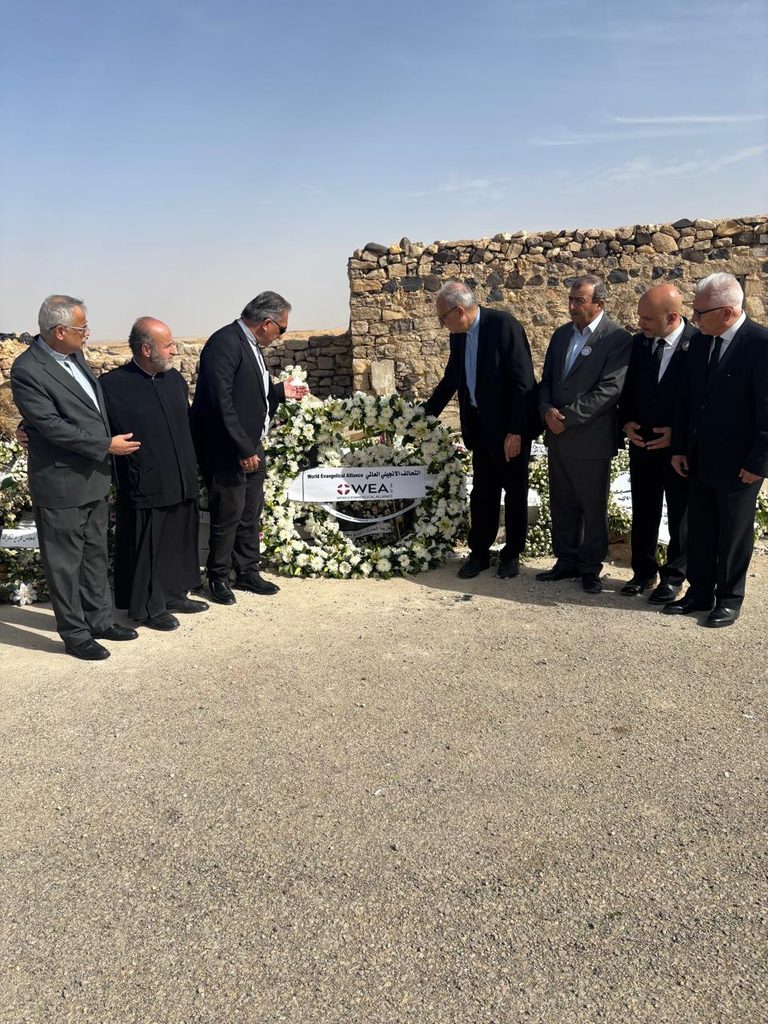
Previous Evangelical delegation lays a wreath at Church in Jordan

By Alfred Asfour
The Palestinian cause has been a central concern for Christian Arabs in the Levant, and especially in Palestine, since the early twentieth century. They were among the first to recognize the Zionist threat to their country, warn against it, resist it, and actively participate in the struggle against it, with some of them becoming martyrs for their homeland.
Christians from Lebanon, Syria, and Jordan shared similar sentiments. In 1905, Lebanese Christian thinker Najib Azoury (1873-1916) wrote “The Awakening of the Arab Nation,” in which he pioneered recognition of the Zionist threat. His vision on this matter was clear and far-sighted. He recognized the Zionist danger early on, warned against it, and emphasized the inevitability of the conflict, alerting the Arabs that their fate, and indeed the fate of the world, was intertwined with this struggle.
Al-Azoury was an early pioneer of Arab nationalism who called for the establishment of an Arab nationalist party, the Arab Homeland League, in 1904, and he published the magazine “Arab Independence” in Paris.
In Palestine itself, Najib Nassar (1865-1948) appeared, who published the Al-Karmel newspaper in 1911 and wrote a book about Zionism in which he warned of its danger to the future of Palestine.
Likewise, Issa al-Issa (1878-1950) played an active role in raising awareness of the dangers of Zionism through the newspaper Filastin, which he published in 1911, and he participated in the founding of the Palestinian National Movement in 1917.
There is also Tawfiq Canaan (1882-1964), who published a book entitled The Question of the Arabs of Palestine, in which he warned of the danger of Jewish immigration and Jewish settlement in Palestine.
Many Palestinian Christian figures also played militant and political roles in defending Palestinian national principles and left a mark on modern Palestinian history.
Among these, for example, are Tawfiq Toubi, Emile Touma, Emile Habibi, Khalil Sakakini, who was one of the founders of the Islamic-Christian Council, George Habash, Asber Al- Munir, Patriarch Michel Sabbah, Bishop Atallah Hanna, Father Ibrahim Ayad, Bishop Elias Khoury, Father Constantine Qarmash, and many others.
As for the government apparatus, they were participants and active in the Palestinian police. In 1923, of 945 policemen, 174 were Christians, including 7 officers.
Despite their small numbers, Palestinian Christians played important roles in Palestine’s modern history. They also had a significant economic role, particularly in trade, education, and the medical professions.
During the British Mandate, Palestinian Christians were especially important, forming a unique community that affirmed its Arab national identity through active participation in the Palestinian struggle and resistance. The Palestinian cause is the cause of all Palestinians, regardless of their background, beliefs, or religion.
As Bishop Atallah Hanna says, the Christian-Muslim relationship in Palestine is one of shared roots, shared belonging, and a shared cause.

Palestinian Christians are among the oldest Christian communities in the world, but emigration and other important factors have significantly reduced their numbers. After the 1967 defeat and the decline of Arab nationalist voices, the Arab Christian voice supporting the Palestinian cause weakened, and the Christian presence in Palestine today barely reaches one percent of the total population according to the latest census in 2017 (47-50 thousand out of four million seven hundred thousand citizens), even though they number more than three million outside Palestine.
In 1850, Palestine’s population was 340,000, of whom 27,000 were Christians. In Jerusalem alone, Christians constituted 25% of the population. By the end of Ottoman rule in 1922, Christians made up 22% of Palestine’s population. However, the decline in the number of Christians in Palestine began in the 1920s.
In 1948, there were 26,000 Christian Arabs in Jerusalem alone, but this number decreased to only 8,000 in 1991, and in 2024 their number did not exceed three thousand.
What applies to Jerusalem also applies to the rest of Palestine’s cities, especially those with a clear Christian presence, such as Nazareth, Bethlehem, Ramallah, Haifa, Lod, Ramla, Acre, and Jaffa.
Naturally, the 1948 Nakba had the greatest impact on reducing the number of Christians, who, like the rest of the population, suffered its effects. Approximately fifty thousand Christians were among the eight hundred thousand Palestinians forcibly displaced from Palestine. Dozens of Christian villages in northern Palestine were also emptied and their inhabitants displaced.
Why has the Palestinian Christian voice become so weak? There are many reasons, varying in their impact, including:
1. The generally turbulent political situation
2. Mass emigration that reduced the number of Christians in Palestine.
3. The decline of the nationalist wave, which was based on Arab Christians, in contrast to the rise of political Islam.
4. Suspicious settlement projects
5. The security and political tensions sweeping the Arab countries, especially in the Middle East.
Although Palestinian Christians are a numerical minority, their status cannot be assessed solely by numbers. They have played a vital role in preserving national identity and in nation-building. They have always been partners in suffering and in building.
The declining number of Christians in Palestine is a source of concern for both the Church and the faithful, and this decline poses a challenge that demands a firm stance. To address this dilemma, we must encourage Palestinian Christians to remain in their homeland by supporting their loyalty to the Church and the nation, and their faith in the mission of the Holy Land. Every believer bears the responsibility for the survival of the Church and its mission, even if it means enduring hardship. The continued presence of Christians in Palestine is not only important but also vital, as they are the true bridge between East and West and can be a genuine force for peace. They are an integral part of the fabric of the Arab people as a whole, and they are a heritage and a witness to the history of faith in this land.
The reality of being a numerical minority compels Christians to emigrate, but emigration does not solve the community’s problems; rather, it exacerbates them. While emigration may address the individual’s needs, it amplifies the challenges faced by the remaining community, adding to their burdens. What are the motives for emigration? Economic, social, political, and security factors, along with the lack of a political horizon and Israeli policies, drive emigration.
Palestinian Christians face Israeli persecution and the oppression of the occupation just like their non-Christian brethren. When Zionist gangs attacked Palestinian villages, they also attacked Christian villages among them. And just as the occupation authorities confiscate Muslim lands, they also confiscate Christian lands and restrict their livelihoods.
Palestinians in general, including Christians, are migrating in search of safety and equality, feeling apprehensive about their circumstances. Like other Arabs, Arab Christians suffered under Ottoman rule, and memories of that era lead many to recall what happened to Armenians, Syriacs, Assyrians, and Chaldeans under Turkish rule.
In some places, Palestinian Christians sometimes experience a form of religious oppression and pressure. Many have faced discrimination, according to a 2020 survey by the Palestinian Center for Policy and Survey Research. That survey also indicated that 43 percent of Palestinian Christians feel unwelcome in the country.
The emigration of Christians from Palestine harms not only Christians but the entire Palestinian entity. Emigration is a national problem, not one specific to a segment of the population. Preserving Christians in their land and homeland is a major responsibility that does not fall on Christians alone, but on everyone in this country.