
Previous Countries that recognized Palestine must be involved in helping end the occupation -book author tells Italians

By Daoud Kuttab
Anyone observing humanitarian work or civil society in Jordan will notice the prominent role Christians play in leadership positions across major organizations. Christian women and men serve at the highest levels of human rights institutions and advocacy groups defending women, people with disabilities, and other marginalized communities.
That presence is a source of pride. But it also raises an uncomfortable question: why has this same energy, courage, and organizational strength not been mobilized around the personal status issues affecting Christians themselves—especially equal inheritance rights?
Among the most urgent of these issues are the unequal (between males and females) distribution of inheritance, a woman’s right to protect her inheritance from being diverted to male cousins, adoption, and other legal matters that weigh heavily on Christian families. These are not marginal concerns. They go to the heart of family dignity, justice, and security.
This is especially important because the reality of Christian family life has changed. Most Christian families today have no more than two or three children, which makes it increasingly common for a Christian family to have only daughters. Yet the inheritance system, based on Islamic Sharia law, continues to discriminate against women—not only in the unequal division of shares with brothers, but also by allowing more distant male relatives to enter the equation at the expense of a woman’s immediate family.
Despite this injustice, one rarely sees serious awareness campaigns, sustained advocacy, or public dialogue from civil society organizations on the diminished rights of Christian women in inheritance matters. That silence is striking. It becomes even more troubling when we remember that the Jordanian government had already signaled its willingness to support any amendments to inheritance and adoption laws on which Christian leaders could agree.
This was a rare opening—perhaps a historic one. Yet most Christian activists, except feminist advocate Lina Naql and a small number of others, did not publicly rally behind reform. Instead, the issue was left largely in the hands of religious leaders. To their credit, those leaders acted responsibly by endorsing a draft law that many lawyers and concerned citizens had long drafted.
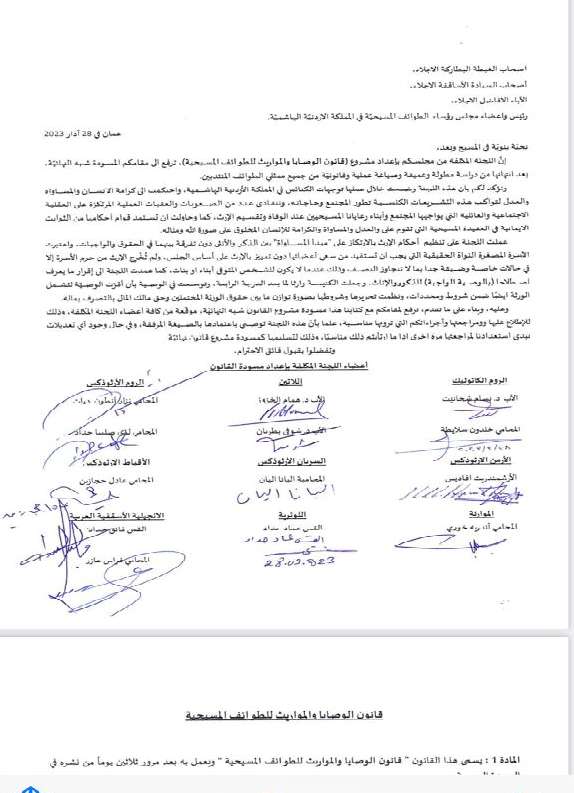
But broad religious and social backing proved insufficient. A small, conservative, male-dominated minority within Christian leadership opposed the reform and managed to obstruct it. As a result, compromise became the default path—not to advance justice, but to appease those determined to block it. In effect, a minority succeeded in frustrating the will of the majority.
That outcome should prompt serious soul-searching.
Where are the women’s associations in cities and towns with strong Christian communities? Where are the Christian charitable societies, the youth groups, the community clubs, and the civic organizations led by Christians? Where are the voices that surely understand the urgency of inheritance equality? Their absence created a vacuum—one that allowed a small minority to exercise a veto over an agreement supported by both religious and secular actors.

The opportunity to amend the inheritance law for Jordanian Christians will not remain open forever. And a strategy of accepting half-measures and hoping to demand more later is unlikely to succeed. On the contrary, it risks producing a weak compromise—especially when the deeply painful issue of excluding widows and daughters in favor of male relatives remains unresolved.
At its core, this debate is not only legal or political. It is moral and spiritual.
The Bible is clear. In James 1:27, true and pure religion is defined by care for widows and orphans in their distress, service to those in need, and moral integrity. How, then, can Christians remain silent in the face of laws that effectively enrich men at the expense of vulnerable families? How can a legal system be defended when it allows a male cousin to claim part of the home and land of widows and daughters simply because there are no sons?
This is not justice. It is not compassion. And it is not faithful to the spirit of Christianity.
If Christian activists are willing to defend the rights of every vulnerable group in society, they should be no less committed when injustice affects their own families and communities. Equal inheritance rights are not a peripheral issue. They are a test of whether justice begins at home—or remains merely a slogan.
The time for silence has passed. Christian civil society, women’s groups, youth organizations, and community leaders must raise their voices and actively advocate for equal inheritance rights. Anything less would be a failure of courage, conscience, and faith.