Previous Support for King Abdullah’s Statement on Christian heritage in Jordan

Daoud Kuttab
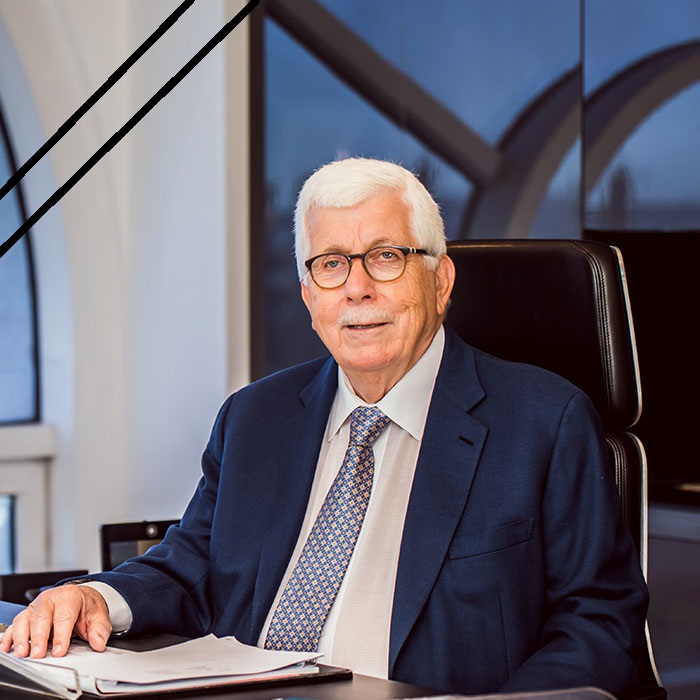
In the presence of family, public officials, businesspeople, and religious figures from various sects, including Orthodox, Copts, Catholics, and Evangelicals, the funeral of the deceased Isam Halim Jreis Salfiti took place on Thursday afternoon at the Umm Al-Hiran cemetery in the Jordanian capital, Amman.
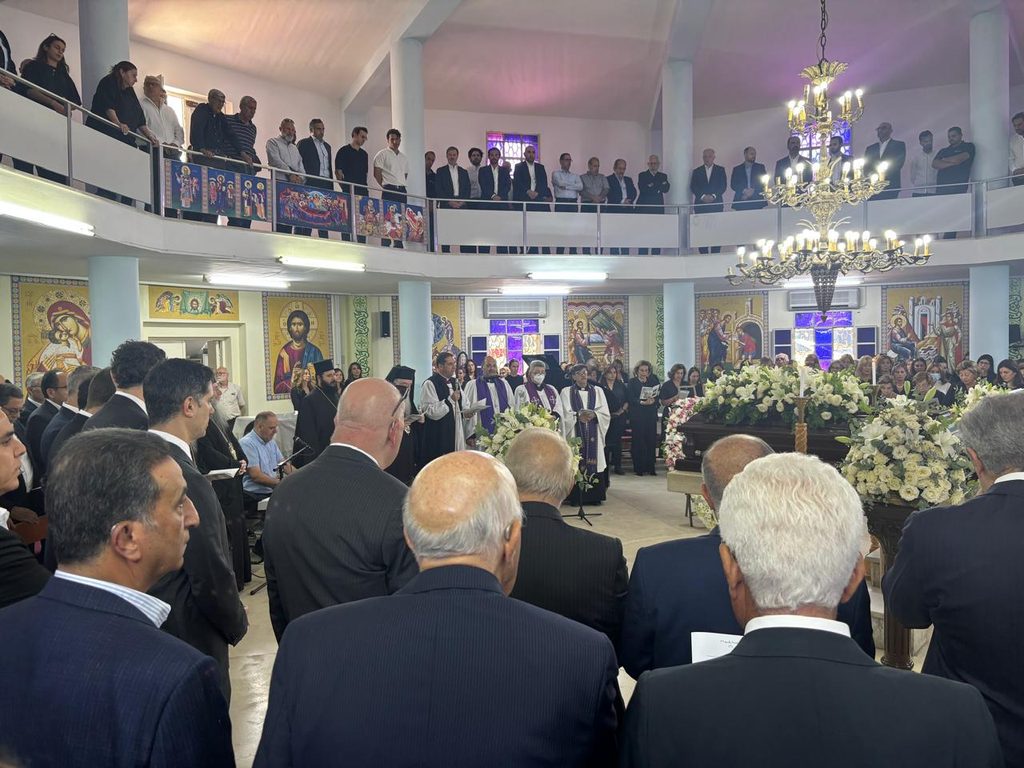
The funeral ceremony was presided over by Archbishop Hossam Naoum, Bishop of the Episcopal Evangelical Church in Jerusalem and the Middle East, with the participation of the President of the Jordanian Episcopal Court ، Archdeacon Fayeq Haddad, the pastor of the Church of the Redeemer in Jabal Amman, to which the deceased belonged, Reverend Canon George Kopti, and Reverend Canon Samir Iseed.
A selection of hymns that the deceased loved were performed,
Pianist Karim Saeed played the hymn “Amazing Grace,” a favorite of the deceased. The program also included a joint reading of Psalm 23 and the Lord’s Prayer.
Bishop Naoum delivered a moving sermon (read the full text at the end of the article) in which he said:
Christ’s word to the family today is a word of hope: “Do not let your hearts be troubled. You believe in God; believe also in me. My Father’s house has many rooms” (John 14:1–2).
To you, Umm Basim, after a journey of marriage and love that lasted more than fifty-five years, we say: May the Lord be near you, and may His grace carry you in the days of separation, and may the memory of the shared years remain a treasure in your heart. And to you, Basim and Ithar, Nadim and Kijan, and Wasim, we say: honor your father’s memory by ensuring the most beautiful things he taught you live on in you. For the most beautiful memorial to a father is not what is written on stone, but what is written in the lives of his children and grandchildren, and in the way they live and give. To my sisters-in-law and Sukkar, to all relatives and friends, to the people of our community in Jabal Amman, to his colleagues and partners, and to all the people of the nation who knew and loved him: Our consolation is the hope of the Resurrection.
The bishop concluded his speech with a call repeated three times, “Christ is risen,” to which the attendees responded, “He is risen indeed.”
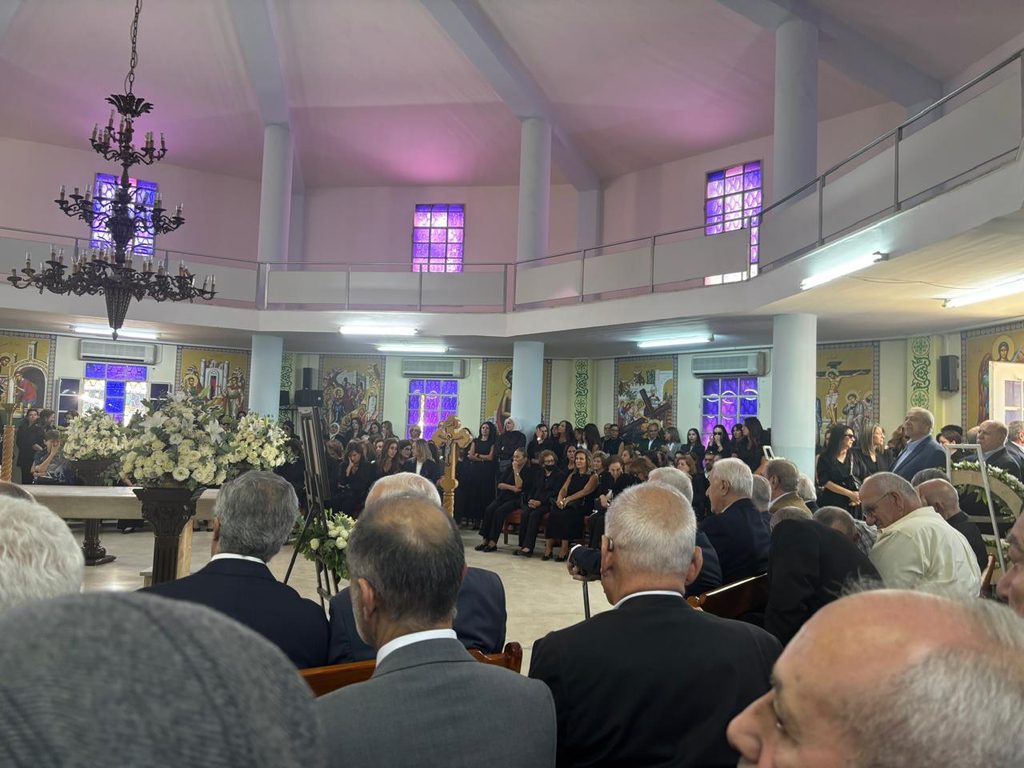
The burial ceremony then took place, attended by all members of the deceased’s family, including his wife, Mrs. Samia Salfiti, and a large gathering of friends. Many attendees offered condolences.
The following is the verbatim text of the funeral sermon:
Funeral sermon of the late, blessed memory of Mr. Isam Halim Jreis Salfiti “Abu Basim”
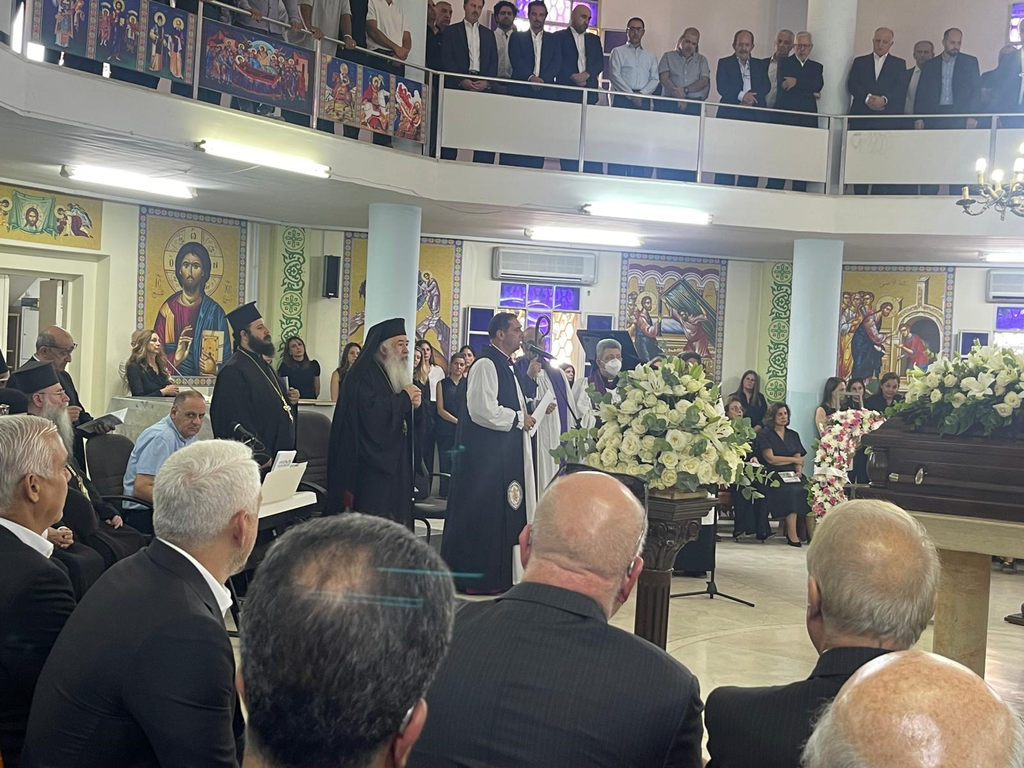
by: Archbishop Hossam Elias Naoum
“I am the resurrection and the life. ” (John 11:25-26)
Today we stand before death, our hearts filled with sorrow at the loss of a dear one, and with gratitude for a long life rich in love, giving, and service. At this hour, the Church lifts us above the pain of separation and invites us to look at death in the light of Christ crucified and risen from the dead.
Our belief in the resurrection is not merely words of comfort we utter when our human words fail us, but it is at the very heart of our Christian faith. For Christ entered death and rose from it, and through his resurrection he opened the way to life for us. Therefore, the apostle Paul boldly asks, “O death, where is your sting? O grave, where is your victory?” …But thanks be to God, who gives us the victory through our Lord Jesus Christ” (1 Corinthians 15:55, 57).
And this is the hope with which we bid farewell today to the late, good, memorable Isam Halim Jreis Salfiti, “Abu Basim”.
When we mention Abu Basim, we mention the man before the businessman and the founder. We mention the husband, the father, the teacher, the supporter, the friend, and the man who believed that the value of success also lies in the good he does in the lives of others.
In his home, he was a loving, affectionate, and devoted husband to his life partner, the dear Mrs. Samia Sukkar, “Umm Basim.” It is a story of shared life, a journey of loyalty, days of joy and challenge, success and hardship, and a family that grew and flourished under the shade of love and faithful partnership.
He was a loving father to his sons Basim and his wife Ithar, Nadim and his wife Kijan, and Wasim. His fatherhood was not just about care and responsibility; he was also a supporter, teacher, and companion. This is one of the most precious legacies a person can leave: values for his children to carry, principles to live by, and memories to accompany them after his voice is gone.
Abu Basem believed in education and learning, and he believed that investing in people is one of the most lasting and impactful investments. That is why he supported students and established scholarships that opened doors for young men and women to complete their education and build their future.
Perhaps one of the most beautiful things we can say about a person after his departure is that many people’s lives have become better because he passed by them
This is the love the Holy Bible describes: “My children, let us not love with words or speech but with actions and in truth” (1 John 3:18).
This verse takes on a special meaning when we consider the life of Abu Basim. His faith and belonging to the Church were evident in his support, generosity, and standing by the Church and its members. He lived Christianity in daily practice: serving humanity, showing generosity, encouraging others, and opening doors for them.
We also mention with appreciation his life partner, Umm Basim, and her long service on the council of the Ahliya and Mutran School. Giving in this house was a way of life, and service was part of the family’s mission and presence in the church and society.
Abu Basem was also a father to many of those who worked with him. He treated employees with a fatherly spirit, humility, and respect, and sought to positively influence people by helping them improve their situations and develop their lives, while respecting their personalities and decisions.
In public and economic life, he was a man of institutions and work. He founded and helped establish many national economic institutions and companies, most notably the Ettihad Bank. Through this journey, he contributed, along with other citizens of this country, to strengthening the Jordanian economy, creating job opportunities, and building institutions that serve the individual and society.
As we enter the second centenary of the Jordanian state, and look forward to the journey of modernization, development, and prosperity under the leadership of His Majesty King Abdullah II bin Al-Hussein, may God protect and preserve him, we realize that nations are built by the hands of their sons and daughters, by their institutions, and by those who see in the success of the institution Success for the community and the nation.
But we in the church, as we bid farewell to a dear person, always return to the deeper question: What remains of the person? The Scripture says: “Blessed are the dead who die in the Lord from now on… that they may rest from their labors, and their works follow them” (Revelation 14:13).
” And their deeds will follow them.”
How profound this statement is on a day like this. Money stays here, positions stay here, institutions are passed down from generation to generation, and great names one day become part of history. As for the good that a person has sown in the lives of others, the knowledge that he helped a young man acquire, the door that he opened for a person, the dignity that he preserved for an employee, the family that he loved, the church that he served, and the homeland that he contributed to building, these are effects that transcend the lifespan of a person.
From here we also understand the words of the Lord Jesus: “Where your treasure is, there your heart will be also” (Matthew 6:21).
Dear friends,
At the funeral, we feel the weight of absence. An empty seat, a voice we miss, a face we were accustomed to seeing, and many moments when we will say to ourselves, “If only Abu Basim were with us.” Therefore, Christ’s word to the family today is a word of hope: “Do not let your hearts be troubled.” You believe in God; believe also in me. In my father’s house are many rooms.” (John 14:1–2)
To you, Umm Basim, after a journey of marriage and love that lasted more than fifty-five years, we say: May the Lord be near you, and may His grace carry you in the days of separation, and may the memory of the shared years remain a treasure in your heart.
And to you, Basim and Ithar, Nadim and Kijan, and Wasim, we say: honor your father’s memory by continuing in you the most beautiful things he taught you. For the most beautiful memorial to a father is not what is written on stone, but what is written in the lives of his children and grandchildren and in the way they live and give.
To the Sukkars, to all relatives and friends, to the people of our community in Jabal Amman, to his colleagues and partners, and to all the people of the nation who knew and loved him: Our consolation is the hope of the Resurrection.
Our life is a gift from God, and death for the believer is a passage into God’s presence. Our last hope is set in him who said, “I am the resurrection and the life.”
And today, as we entrust our brother Issam to God’s mercy, we thank the Lord for all that He gave him throughout his life: for the home he loved, for the family he cared for, for the students he supported, for the employees he treated as his own children, for the institutions he helped build, for the church he loved and supported, and for the country that he served from his position and work.
We pray that the Lord will receive him in His light and peace, and that He will grant Umm Basim, his children, his family, and all who love him the comfort of the Holy Spirit and the strength of hope.
Let the words of the Apostle Paul be our prayer and hope at this hour: “For if we live, we live to the Lord, and if we die, we die to the Lord. So then, whether we live or whether we die, we are the Lord’s” (Romans 14:8). Blessed is he whose love remains in the hearts of his family, whose giving remains in the lives of people, and whose deeds remain as witnesses to a life given and served with love.
Grant him eternal rest, O Lord, and perpetual light; let him rest in peace, and rise in glory. Amen.